1978: The Catalyst Publications
In December 1978, I Nostri Cani magazine featured two crucial pieces:
- Paolo Petrelli’s Notice (Issue #6): Described short-coated molossoids distinct from the Neapolitan Mastiff, spotted in southern Italy.
- Paolo Breber’s Field Report: Detailed encounters with original Corso-type dogs in Puglia, prompted by a 1973 note from Prof. Bonatti hinting at their survival.
May 1979: Gandolfi’s Mission
Inspired by Breber’s account, young breeder Stefano Gandolfi mobilized in spring 1979. Partnering with German Shepherd experts Giancarlo and Luciano Malavasi, he embarked on exploratory trips to Puglia. Their goal: identify and secure the few remaining pure Cane Corsos.
September 1979: The Foundational Dogs
The first expedition yielded six cornerstone dogs:
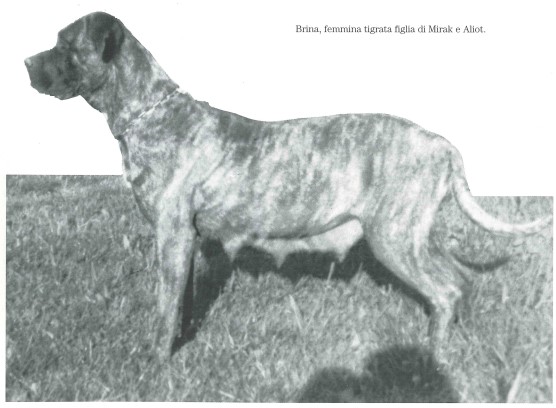
- Alma & Cocab (b. 1978) – Brina’s daughters exhibiting classic scissor bite.
- Tipsi – Noted for her balanced proportions and reverse scissor bite.
- Tappo – Brina’s lone male, relocated from Foggia.
- Picciut – A brindle male with exemplary molossoid structure.
- Additional specimens from 1975 litters, enriching genetic diversity.
These dogs embodied the Cane Corso’s mesomorphic build and working heritage, distinct from other mastiff breeds.
Late 1979 – Early 1980: Centralizing Breeding in Mantova
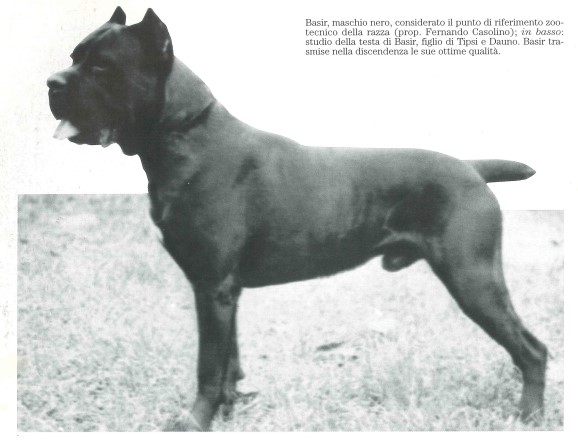
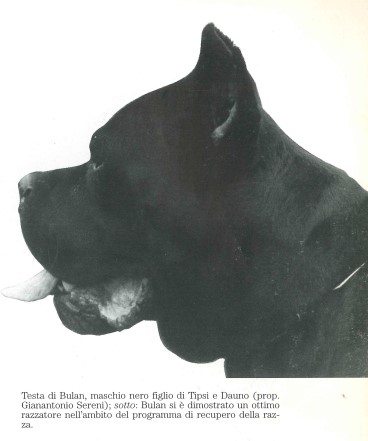
Facing scattered ownership and dwindling numbers, the Malavasi brothers offered their Mantova kennel as the central hub. Key foundation trio—Tipsi, Brina, and her brother Dauno—were brought together, producing the first modern Corsos such as “Basir” and “Bulan.”

These early litters solidified the breed’s phenotype: athletic, agile, and protective. The collaboration also marked the inception of record-keeping for pedigrees and health data.
October 18, 1983: Official E Valuation & SACC Formation
On October 18, 1983, a landmark evaluation in Mantova gathered 12 adult Corsos before Dr. Giovanni Ventura (ENCI judge). Observations highlighted typical prognathism, convergent craniofacial axes, and ideal weight ranges—47 kg for males, 38 kg for females.
That afternoon, the Società Amatori Cane Corso (SACC) was formally established with founding officers:
- President: Stefano Gandolfi
- Vice Presidents: Paolo Breber & Luciano Malavasi
- Secretary: Fernando Casolino
- Treasurer: Giancarlo Malavasi
- Director: Gianantonio Sereni
Twenty enthusiasts, including M. Angiolillo, G. Bonatti, G. Ventura, and V. Suffritti, signed the charter, embedding governance and breed standardization protocols.
1985–1987: Path to ENCI Recognition
In 1985, SACC coordinated with ENCI judges—Bonetti, Morsiani, Perricone, and Bussadori—to showcase the Cane Corso at national gatherings. By June 16, 1985, ten Corsos were presented; a formal ENCI panel visited Mantova in November.

Expeditions to Calabria, Umbria, and Sicily between 1985–86 added over thirty dogs from eleven bloodlines, enriching the gene pool. Dr. Antonio Morsiani’s morphological analysis of 50 specimens culminated in the official Cane Corso standard approval by ENCI in November 1987. Full FCI status followed in 1994.
Key Figures & Contributions
- Stefano Gandolfi – Visionary breeder, first SACC President.
- Luciano & Giancarlo Malavasi – Kennel hosts, vice presidents, and early genetic managers.
- Paolo Breber – Field researcher and vice president.
- Fernando Casolino – Secretary and ENCI liaison.
- Antonio Morsiani, Mario Perricone – Standard drafters and judges.
Legacy & Continuing Mission
From the foundational breedings of 1979 to thousands of global members today, SACC’s legacy thrives in health programs, working trials (CAL1-3), and educational seminars. The Society’s DNA profiling project ensures genetic diversity, while rescue initiatives support abandoned Corsos across Europe.
For ongoing events and historical archives, visit the official SACC site.