The Cane Corso, a modern icon of strength and loyalty, carries within its muscular frame a history that reaches back to the dawn of European civilization. This ancient Molosser breed, born from centuries of selective breeding and cultural significance, was far more than a working dog—it was a warrior, a guardian, a status symbol, and a companion to emperors, generals, and farmers alike.
Drawing from “Il Cane Corso – Origini e Prospettive del Molosso Italico” by Ferdinando Casolino and Stefano Gandolfi (Mursia, 1996), this article explores the Cane Corso’s role in Classical Antiquity, focusing on Greco-Roman civilization, military usage, symbolism in literature and sculpture, and its relationship with human societies across centuries.
The Molosser in the Classical World
In Greco-Roman society, large dogs known as Molossers were famed for their power and tenacity. Named after the Molossians of Epirus, these dogs were used for guarding livestock, protecting property, and participating in war. The Cane Corso descends from these ancient war dogs, gradually adapted into a rural guardian through centuries of selection and functional use in Italy.
Writers such as Aristotle and Virgil described the presence of such dogs in the Balkans and across Gaul and Germania. These dogs, possibly introduced by Celts and Illyrians, were valued by both Greeks and Romans for their size, aggression, and loyalty.
Excavations in Germany and France have uncovered skeletal remains dating back to 1000 BCE that resemble early Molosser types, affirming their widespread use across pre-Roman Europe.
Dogs of War: From Persia to the Roman Empire
The Persians were among the first to deploy Molosser-type dogs in organized warfare. Historical sources mention the gifting of powerful dogs to kings, such as those received by Cyrus the Great. Aristotle even claimed these dogs descended from lions and tigers, emphasizing their fearsome appearance.
As Rome expanded, it absorbed and adapted these practices. Roman legions are believed to have used Molossers in major battles like Heraclea (280 BCE), Asculum (279 BCE), and Pydna (168 BCE). These dogs were often armored with metal collars or mail vests and were trained to charge enemy lines or guard camps at night.
Writers like Pliny the Elder and Varrone detailed the classifications of Roman dogs: venatici (hunters), pugnaces (fighters), and pastorales (guardians). The Cane Corso, although not named directly, fits the morphological and functional profile of the canes pugnaces described in Roman sources.

Cultural Depictions and Urban Use
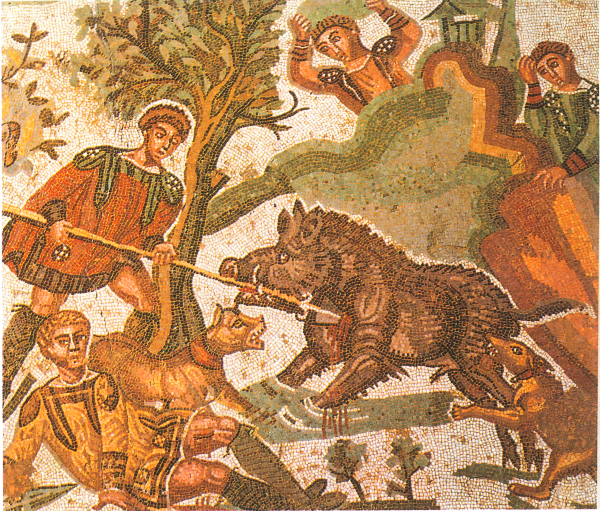
In Roman villas, Molosser statues and mosaics depicted the dogs as protectors and prestigious symbols of wealth. Terracotta guardians were placed at doorways to ward off spirits, some labeled with inscriptions such as “Conqueror of Enemies” or “Fierce Biter.”
The Roman poet Virgil described large dogs bred in Epirus and used in Italy for both protection and spectacle. Later, these dogs became part of the urban defense structure, guarding estates and even serving the police functions in large cities.
Symbolism and Spectacle: The Cane Corso as Icon
Beyond combat, Molossers entered the arena as gladiators. In Roman circuses, they were pitted against wild animals, sometimes alongside criminals. These spectacles solidified the dog’s reputation for fearlessness and endurance, traits passed down in today’s Cane Corso.
In art and mythology, dogs represented loyalty, guardianship, and even sacrifice. Stories recount dogs saving their masters from fire, drowning, and enemy attacks. One such tale tells of Delta, a Cane Corso-like dog who saved a Roman official’s life multiple times, becoming a local hero.
By the time of the Flavian dynasty, Molossers were widespread throughout the empire—from Britain to North Africa—and had become essential to both urban and rural life. Though Roman society eventually declined, the legacy of these dogs survived in Italy’s countryside, where they continued to guard farms, hunt boars, and protect families.
Conclusion
The Cane Corso’s classical legacy is more than myth or nostalgia—it is a story of adaptation, resilience, and enduring functionality. Rooted in war and protection, shaped by centuries of practical use, and immortalized in art and text, the Cane Corso is a living monument to the relationship between man and dog in Western civilization.
Discover how the Cane Corso evolved from the Middle Ages to the present day.