The Medieval Transition: A Breed Beyond Empire
As the grandeur of Rome faded and feudal Europe took shape, the Cane Corso did not vanish—it adapted (Read about the Cane Corso in classical antiquit). In the chaos of post-imperial Italy, this powerful dog found a new identity, no longer a war beast of Caesar’s legions but a guardian of homesteads, a hunter of wild boars, and a symbol of Italian resilience.
The fall of centralized Roman authority created fragmented societies in which security became a local responsibility. This shift gave rise to new uses for working dogs like the Cane Corso. Where once they marched with soldiers, now they stood guard over sheep pens, vineyards, and noble villas.
Roles in Rural and Feudal Italy
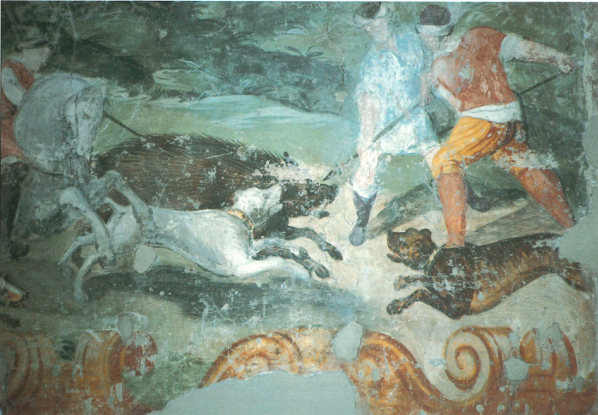
In medieval times, the Cane Corso served a diverse range of purposes. Its most legendary role was that of the wild boar hunter. These hunts were not mere sport—they were dangerous endeavors in which the Corso’s courage was tested to the limit.
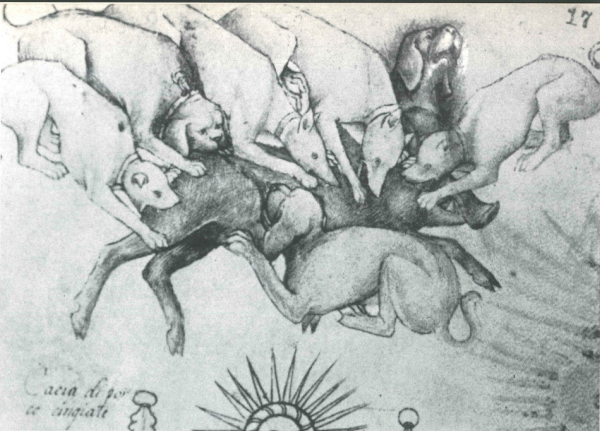
Historical sources, including the 1390 manuscript by Giovannino de’ Grassi, depict scenes of fierce boar hunts with large molossoid dogs confronting dangerous game head-on. The Corso was often the first to engage the boar, holding it long enough for hunters to land the fatal blow.
Beyond hunting, the Cane Corso excelled as a guardian of rural farms. It patrolled land boundaries, deterred bandits, and even herded livestock. Its adaptability made it a perfect companion for both nobility and peasantry.
Cultural Reflections: The Corso in Art and Poetry
Throughout the Renaissance, the Cane Corso earned a place in Italy’s cultural imagination. Literary references and artworks paid homage to its noble qualities. In Balbus, Teofilo Folengo describes a scene where Corsos fearlessly circle and bring down a bear, their courage matched only by their loyalty.
Erasmo da Valvasone, in his poetic work La Caccia, writes:
“Il Corso ha gran possanza, ardito assale
La fera, et la ritien: poiché l’ha presa,
Sciorre il dente non sa…”
This verse captures not just the dog’s physical power, but its instinctive loyalty—a theme repeated across multiple texts from the 15th and 16th centuries. These dogs were portrayed not only as protectors but as moral symbols: steadfast, incorruptible, and faithful to their human families.
A Warrior’s Physique: Characteristics in the Middle Ages
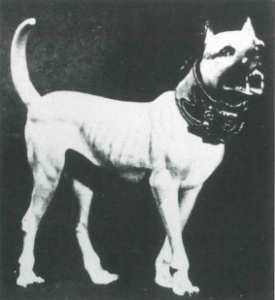
Descriptions of the Cane Corso from medieval times point to a dog with a broad head, strong neck, and compact yet athletic frame. Many were depicted with cropped ears—a practical choice to prevent injuries during hunts or fights.
The coat was short and dense, perfect for the rugged Italian countryside. Strength, agility, and endurance defined the ideal form. What is striking is how consistent these traits remain in today’s Cane Corsos, a testament to centuries of selective breeding and practical use.

Southern Italy and Symbolism: The Cane Corso’s Cultural Peak
In the Kingdom of the Two Sicilies, particularly under the Bourbon dynasty, the Cane Corso reached its symbolic height. It was not only a functional working dog but also a part of popular culture. In Neapolitan nativity scenes from the 1700s, Cane Corsi are depicted among the figurines—a rare honor for an animal.
One such sculpture shows a fawn-colored Corso with a black mask, watching over shepherds and peasants. This visual metaphor positioned the dog as a protector of the people, their land, and their way of life.
The dog also appears in folk sayings and dream symbolism. In Neapolitan lottery books, dreaming of a Cane Corso could imply strength, aggression, or divine protection. The breed had become more than a working animal—it was a psychological and cultural archetype.
Echoes in Modern Times: Heritage and Revival
By the 19th and early 20th centuries, industrialization and war nearly erased the Cane Corso from Italy’s rural map. But a handful of farmers and enthusiasts in the south preserved its bloodline. In recent decades, thanks to the work of historians, breeders, and organizations like SACC, the breed has been carefully revived to reflect its original function and appearance.
Today’s Cane Corso is not a reinvention, but a faithful heir to its medieval ancestors. Its history is not just pedigree—it’s identity.

Conclusion: Why the Middle Ages Matter
Understanding the Cane Corso’s evolution during the Middle Ages gives us more than context—it provides reverence. This breed, shaped by war, work, and worship, has earned its place not just in fields and homes, but in the heart of Italian heritage.
For those who own, breed, or admire the Cane Corso today, honoring this lineage is not just a duty—it’s a privilege.