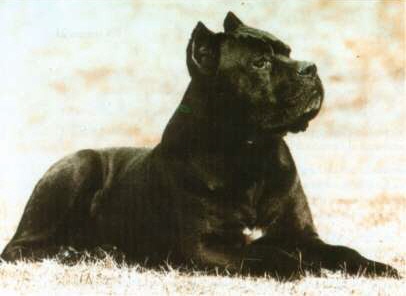
Cane Corso Standard
Index
General Information
Scientific Classification. Mégnin (1897) divides all dog breeds into four groups (lupoid, braccoid, molossoid, graioid). Specifically, for molossoid he refers to dogs with the following characteristics: large, round or cuboid head; small drooping ears; short muzzle; long and thick lips. Massive body. Normally large-sized types. Déchambre (1924) adopts a classification based on the relationship between the upper longitudinal axes of the skull and muzzle, resulting in three profile types: straight or orthoid, concave or celoid, and convex or cirtoid. For more detail, refer to the description of the head.
Utilitarian Classification. We have seen how in the past the breed had a much broader field of use, confirming its versatility.
Origin. Historiography and iconography show that in the past the breed was widespread throughout Italy, albeit with different regional characteristics.
General breed-defining traits. Dogs are divided into three fundamental morphological types, based on the comparison of longitudinal and transverse diameters:
- mesomorphic or medium-limbed type, where the proportions between "heights" and "widths" are well balanced (e.g. pointer);
- dolichomorphic or long-limbed type, where "heights" prevail over "widths" (e.g. greyhounds);
- brachymorphic or short-limbed type, where "widths" prevail over "heights" (e.g. bulldogs).
This classification can be expressed with indices, which are the ratio in percentage of one measurement relative to another taken as a reference point. The main indices are three: body index, thoracic index, and cephalic index.

Body index expresses the mass intensity in relation to trunk length and is calculated with the following formula:
Body Index = trunk length X 100 / thoracic circumference
The morphological types have the following body indices:
- brachymorphs: 50 to 70;
- mesomorphs: 70 to 85;
- dolichomorphs: 85 to 100.
In the Cane Corso, the body index is approximately 80 (mesomorphic).
Thoracic index expresses thorax development in relation to morphological type and is calculated with the following formula:
Thoracic index = chest width x 100 / chest height
The morphological types have the following thoracic indices:
- brachymorphs: 90 to 100;
- mesomorphs: 60 to 90;
- dolichomorphs: 50 to 60.
In the Cane Corso, the thoracic index is about 70 (mesomorphic).
The Cane Corso is harmonious in structure (structure is defined by height and mass, i.e. bulk), meaning its mass is harmoniously distributed.
The Cane Corso is disharmonious in profile, since the head has a concave profile (converging craniofacial axes), while the trunk has a straight profile.
Constitution type. The habitus is the complex of features that distinguish an animal species. The renowned French zootechnician Sigaud identifies four basic types based on the dominance of a certain anatomical area over the rest: cerebral (dominance of the head, e.g. bulldog), digestive (dominance of the belly, e.g. Neapolitan mastiff), respiratory (dominance of the thoracic region, e.g. greyhound), muscular (dominance of the muscle masses, e.g. boxer).
Complexion refers to the physical build. When classified based on the muscle efficiency in transforming oxygen particles carried by the cardiovascular system into motor energy (muscle contraction or extension), it may be hypo-oxidative (low efficiency), normal (normal efficiency), or hyper-oxidative (high efficiency).
The Cane Corso exhibits a muscular habitus with a barely perceptible tendency toward the respiratory habitus. The complexion is normal or slightly hyper-oxidative.
Head
Head. The heads of canine breeds can be classified into three fundamental morphological types by comparing the head’s length with its width. To do this, the cephalic index is used, calculated as follows:
Cephalic Index = head width x 100 / head length
The three morphological types have the following cephalic indices:
- brachycephalic: cephalic index over 54;
- mesocephalic: cephalic index between 50 and 54;
- dolichocephalic: cephalic index below 50.
In the Cane Corso, the cephalic index ranges from 64 to 66, thus it is clearly brachycephalic.
As discussed, dog breeds can be classified into three types based on the orientation of the craniofacial axes (longitudinal axes of skull and muzzle). Experts often draw these lines by eye, but precise determination requires a caliper.
The skull's upper longitudinal axis runs from the craniometric point “inion” (at the top of the external occipital protuberance) to the point “nasion” (where nasal bones meet frontal bones).
The muzzle’s upper longitudinal axis follows the top profile of the nasal bridge from nose to stop. Based on these axes, the craniofacial profiles can be:
- parallel: the axes never meet (straight profile), e.g. German Shepherd, Great Dane, Mastiff, Neapolitan Mastiff;
- convergent: the axes meet forward (concave profile), the backward projection of the muzzle axis always falls behind the occipital crest, e.g. Cane Corso, Boxer, Dogue de Bordeaux, Pointer, St. Bernard;
- divergent: the forward projections of the axes do not meet (convex profile), the muzzle axis projected backward falls in front of the occipital crest, e.g. Italian Bracco, Borzoi, Bloodhound, Bull Terrier

In the Cane Corso, convergence is an essential ethnic trait. There are two types:
- monoconvergent: only the skull axis converges toward the muzzle axis;
- biconvergent: both skull and muzzle axes converge.
The Cane Corso, like the Pointer, St. Bernard, Bullmastiff, etc., is monoconvergent.
The Boxer, Bulldog, etc., are biconvergent. In the Cane Corso, biconvergence occurs in the hypertype; conversely, parallelism is found in the hypotype, and divergence always leads to total disqualification.
Nose. A small nose is usually associated with conical muzzles (to be disqualified).
Some specimens may have an otherwise well-formed muzzle (broad with parallel lateral sides) but with a narrow nose. In such cases, the head loses typicality, especially in males, and should be penalized. The nose must not be sunken or protruding forward (common in dogs with parallel or divergent craniofacial axes), nor should it be tilted backward or raised above the nasal bridge (common in hypertypes).
Nasal bridge. Given the parallel sides of the muzzle, the nasal bridge must maintain the same width from base to tip. Roman noses are often associated with parallel or divergent axes. Sometimes a bump appears mid-length on the nasal bridge—this is undesirable. A slightly concave profile often accompanies short muzzles and backward-slanting noses, typical of hypertypes (should always be penalized for reducing the dog’s noble expression).
Lips and muzzle. In some dogs, the front of the muzzle is not flat and wide but curves into the sides due to insufficiently wide upper jaws. In these cases, if the upper lips are well developed but lack adequate support, they form an inverted V instead of the typical U. This trait is typical of convergent muzzle sides and must be severely penalized.
Poorly developed, tight, receding lips are to be penalized (usually found in conical muzzles). Excessively developed lips often come with loose skin and distort the breed’s typical expression: also to be penalized.
A non-negotiable breed characteristic is that muzzle width equals its length, and that muzzle height at the base is at least 1/3 greater than its length.
Therefore, the muzzle is as long as it is wide. Excessive chiseling under the eyes gives the head a gaunt, aged look.
Lack of chiseling robs the head of its typical expression.
Jaws. In the Cane Corso, slight undershot bite is defined by a 5 mm overstep of the lower incisors over the upper ones. This 5 mm is an optimal average. Scissor bite (where upper incisors slightly overlap the lower ones) and a 10 mm overstep are only tolerated.
A flat lower jaw (shovel-shaped) must be rejected—it leads to a weak muzzle structure. Additionally, this often results in a receding chin that is not touched by the upper lips, which diminishes the muzzle’s incisiveness and is disqualifying (common in conical muzzles).
Overshot bite, caused by underdeveloped lower jaw, if severe, is incompatible with survival; such dogs must be excluded from breeding and disqualified. In a working breed like the Cane Corso, a well-curved lower jaw and a marked chin are essential for a firm grip. On the other hand, excessive undershot bite compromises grip strength.
The wide separation of canines and the broad development of the maxillae cause the upper lips to slightly bulge outward, so that the front muzzle (viewed from the front) forms an isosceles trapezoid with the wider side at the bottom. Missing P1 premolars on one or both arches is not a major defect in this brachycephalic breed. However, absence of larger premolars must be severely penalized, as it usually indicates an abnormally short muzzle. Powerful dentition proportional to the head’s size is crucial.

Stop (naso-frontal depression). The depth of the stop can be visually assessed in profile by estimating the angle of the nasal-sinus junction (between the muzzle’s upper axis and the frontal bulges). However, a precise evaluation is made using the craniofacial angle (formed between the upper longitudinal axis of the muzzle and the axis passing through the median groove, which starts at the stop and disappears mid-skull near the craniometric point “bregma”). In the Cane Corso, this angle should be approximately 130°.
Some specimens, despite having a correct nasal-sinus angle (105°–110°), due to poorly developed frontal bulges, show either a shallow or overly deep median groove. Such variations alter the craniofacial angle and must be rigorously addressed.
Skull. The skull, like the muzzle, should be as wide as it is long. This is a key breed trait in the Cane Corso. A flattened skull is mainly due to either an overly prominent occipital crest/sagittal crest (seen in dogs with parallel or divergent craniofacial axes), or overly developed temporal muscles which inhibit skull growth (skull appears wide laterally but flat on top, with flattened frontal bulges and brow ridges).
A globular skull, typical of hypertypes, occurs when normal skull and zygomatic arch development combines with hypertrophied temporal muscles (skull appears full at the parietals, brow ridges round out, and the prescribed slight hollow of the temporal fossae disappears, giving a coarse and atypical expression). Excessively sunken temporal fossae result from hypotrophic head muscles (producing a bony, gaunt, aged appearance).
Cheeks. Hypotrophic masseter muscles make the head appear too light and delicate, while hypertrophic ones (bulldog-like) remove its nobility.
Eyes. Deep-set, small, or overly protruding eyes must be severely penalized as they alter the breed’s appearance.
Frontal eye positioning (where the eyelid axis forms a right angle with the head’s median axis) should be penalized as it indicates coarse hypertypes and is often paired with round eyelids and exophthalmos (bulging eyes). A worse defect, even in females, is semi-lateral eye placement, often seen with almond-shaped eyes. In good males, eyes should be well spaced—close-set eyes change the expression and are often linked to narrow frontal bulges and flat skulls.
Eyelids must adhere closely to the eyeball, with no ectropion (outward rolling, common in lymphatic dogs) or entropion (inward rolling). Regardless of coat color (even light fawn or light gray), eyelid margins and the third eyelid must be black-pigmented. The iris color is significant in the Cane Corso, as the standard requires it to be as dark as possible in relation to coat color, allowing a wide range of hues from light fawn and gray to dark brindle and black.
In general, the iris should match the darkest tones of the coat, excluding the mask. For example, it should be dark hazelnut in black and dark brindle coats, and progressively lighter in fawn and gray coats. Even in the lightest coats, the iris must not be lighter than hazelnut, as it is correlated with nose and eyelid pigmentation (both of which are black in the Cane Corso). “Gazzuolo” eye (iris faded from slate to blue) indicates underdevelopment and is always a congenital defect, requiring disqualification.
Ears. The tradition of ear cropping has led many breeders to overlook proper ear placement and proportions. However, since cropping may be banned, the correct ear set and expression are increasingly important.
With intact ears, a too-wide base results in “butterfly ears,” while a narrow base leads to drooping ears, which ruin the head’s angular and marked appearance. Both faults diminish nobility and typicality.
Body
Trunk. The Cane Corso has a rectangular build, with the trunk length being 11% longer than the height at the withers.
Chest. Chest width is measured using the tips of the shoulders as reference points. When, due to poor muscular development, the sternum margin appears too prominent (knife-like chest), the dog must be severely penalized.
Thorax.
Height. A rough evaluation of thoracic height can be made by checking if the lowest point of the sternum and the olecranon (bony tip of the elbow) are aligned. However, a correctly dimensioned thorax may appear too low if the withers are underdeveloped—this reduces the distance between elbow and withers and lowers the sternum beyond the level of the elbows (a penalizable fault). Sometimes in females (especially pregnant ones), older dogs, or those with relaxed shoulder girdles, a perfectly shaped thorax may still appear too low. A thorax lacking height affects functionality (a very serious fault).
Width. Visually, chest width and chest breadth should roughly match. Flat chests must be eliminated. Barrel chests, which hinder movement and reduce nobility, should be penalized, as should narrow or keel-shaped chests. Keel chests, caused by a sudden decrease in transverse diameter at the bottom of the rib cage, create a gap between chest and elbow, making the latter loose or swinging. This defect is common in young, long-limbed, and large-sized dogs. If the transverse diameter exceeds 35% of the height at the withers, the dog appears wide in front with too-separated forearms; if under 35%, it appears narrow in front with overly close forearms. The latter defect is more serious and should be strictly penalized.
Depth. Thoracic depth is crucial, as it relates to intercostal space and rib slant. A shallow chest almost always means poorly slanted ribs and reduced inspiratory capacity (very serious defect). A small thoracic circumference also compromises functionality.
If the xiphoid process (the lower tip of the sternum) curves inward (often from rickets), it shortens the costal cartilages and reduces chest capacity. The abdomen will appear tucked up because abdominal muscles attach to the xiphoid process (this is penalizable).
Withers. Anatomically based on the first five thoracic vertebrae and the top of the shoulder blades, the withers form the highest point of the topline. Since the height of the spinous processes increases to the fifth thoracic vertebra and then decreases, height at withers is measured from this point to the ground.
A prominent and long withers is an essential trait in a working breed. It indicates long and slanted spinous processes which serve as levers for the back muscles, cervical ligament, and shoulder elevators (trapezius and rhomboid muscles). The taller the spinous processes, the greater the contraction of the shoulder muscles, increasing forelimb swing and strengthening the back and loins. Additionally, high withers are usually paired with well-angled shoulders, optimizing movement. Low, short withers make the back appear long and, combined with a tight scapulohumeral angle or excessive arm slant, shift the dog’s center of gravity forward. The result is a dog “thrown onto the front,” with clumsy and weak movement due to poor front leg extension and reduced rear propulsion.
High, short withers prevent smooth blending with neck and back, creating an abrupt topline break. When shoulder tips are too high and close together, the so-called “knife-edge withers” occur (rare). If withers are fatty (“fleshy withers”), they are usually also low (serious defect).
Back. The back supports the body and transfers rear propulsion to the front. A strictly straight and slightly rising back from rear to front optimizes rear-to-front energy transfer. This shifts the center of gravity rearward, lightens the forehand, and enhances forward motion.
Kyphosis or roach back means a convex spinal profile in the thoracolumbar region, often linked to rickets and calcification of intervertebral cartilage. Dogs with this issue are shorter, less flexible, and suffer limited movement and poor gait due to weakened rear propulsion.
Lordosis or sway back refers to a concave spine, usually from the withers to the croup, caused by weakened vertebral ligaments, short withers, or long back and loins.
This serious fault must be severely penalized in the Cane Corso. Dogs with lordosis or kyphosis use excessive energy compensating for unnatural spine curvature, further hindering performance.
Loins (Loin or Kidney area). A short, broad, and solid loin is a critical functional asset, able to compensate for many other anatomical flaws.
The loin should be short, as a short “bridge” is structurally stronger than a long one. A long loin results in unstable hindquarters and poor motion transfer. The loin should be broad—well-developed transverse vertebral processes mean well-developed surrounding muscles. A narrow, weak loin is always fragile. Sloping or knife-edge loins are unacceptable and should be penalized. A low, sunken loin poorly joined to back and croup weakens energy transfer from the hindquarters, forcing the dog to use excess energy to maintain posture.
The loin’s profile should be slightly convex, since this shape best suits the flexing and stretching needed for trotting and galloping. A flat loin is rigid and hinders movement. Always check the loin’s firmness by hand.
Belly and Flanks. The belly profile closely corresponds to the back’s shape.
A deeply tucked-up belly typically accompanies a convex back; a flat or sagging belly often aligns with a concave back. The same observations on kyphosis and lordosis apply. However, a sagging, bloated belly may also result from obesity, poor diet, worms, or lymphatism.
Croup. The croup is crucial for motion mechanics—it transfers hindquarter impulses to the forehand. Its slope (along the pelvic axis) directly affects hind limb musculature (gluteal and especially hamstring muscles) and therefore rear angulation. The femur and pelvis form an angle between 90° and 120°, and since the metatarsus is always perpendicular to the ground, thigh and leg slant depend on croup inclination.
See the hindlimb section for more detail.
A flat croup (typical of galloping dogs) requires long hamstring muscles for wide hind leg swings. A sloped croup (seen in trotters) pairs with shorter muscles. In the Cane Corso, the croup is slightly sloped, matching its natural extended trot gait.
The croup must be long to ensure effective propulsion. Width is linked to skeletal structure and muscle development. In the Cane Corso, the croup should be wide, as the breed needs strength more than speed.
A severely sloped croup (over 35°) is a serious fault—short, weak hamstrings make the dog stand with rear limbs nearly vertical, resulting in straight stifles and poor gait. This often comes with a higher croup than withers and excessive weight on the forehand, leading to clumsy movement. Equally serious, though rarer, is an overly flat croup (under 15°), which straightens the femur-tibia angle and restricts movement, especially if the croup is also short.
Tail. When at rest, the Cane Corso's tail should resemble a “fishbone.” Thick at the root and tapering, the fatty tissue over the caudal vertebrae gives it this V-shaped resting form. A low tail set usually indicates a sloping croup. A thin-rooted tail often results in a “candle” tail in motion (should be penalized).
Testicles. Males must have two normal, fully descended testicles.
Limbs

Forelimbs
Correct profile alignment:
- The vertical line dropped from the tip of the shoulder to the ground should skim the toes;
- The vertical line from the elbow joint center should divide the limb into two nearly equal parts (the front part slightly longer) and touch the ground just behind the foot.
Correct front view alignment:
- The vertical from the shoulder tip should divide the forearm, body, pastern, and foot into nearly equal halves;
- The length of the limb to the elbow equals half the height at the withers.
Shoulder. The shoulder is vital in locomotion mechanics, as it anchors the muscles responsible for movement of the arm and forearm, affecting stride length. A long, muscular shoulder yields a longer stride. A short shoulder, often steep, restricts movement and construction due to excessive arm inclination, pushing the trunk forward and shifting the center of gravity. The shoulder must be long, well-angled, and mobile. Penalize shoulders that are fatty, weak, stiff, or with a relaxed girdle, or with tips too close or far apart.
Arm (Humerus). Arm length correlates with scapula length. Its inclination compensates for scapula positioning. Straight shoulders often result in overly slanted arms (causing "forward-thrown" dogs with overloaded feet and poor lift). Conversely, overly angled scapulae cause too straight arms, shifting the center of gravity back and overloading the rear, leading to erect neck carriage. Both faults must be penalized. Ideal arm inclination: 58°–60°, with scapula-humerus angle: 106°–110°.
Forearm. The back of the forearm has a groove (carpal-ulnar sulcus) formed by the flexor carpi ulnaris tendon inserting into the pisiform bone, acting as a lever. The more developed the pisiform bone, the more effective the lever (stronger forearm) and deeper the groove. Elbows turned outward (open) often cause bowlegs; inward elbows cause cow-hocked forelegs. The latter is more frequent in the Cane Corso.
Short, thin, weak forearms (often linked to narrow chests) are to be rejected. Arched forearms (spongy bone) always indicate rickets.
Wrist (Carpus). The carpus in Cane Corso puppies is hypertrophic, often with noticeable bony swellings, not to be mistaken for rickets—this is only penalized in adults. Bone overgrowth (exostosis) suggests chronic irritation (very serious fault).
Sometimes the wrist is projected forward (goose-wristed) or curved back (swayed), both misalignments. Often, the carpus is deviated inward (varus), causing the pastern and foot to rotate outward (cow-footed), or outward (valgus), causing inward rotation (pigeon-toed). The first defect is more common in the Cane Corso. If the pastern is stiff (upright), the dog walks "on tiptoe"—a rare fault in this breed.
Pastern. The pastern acts as a "shock absorber" between the upper limb and foot, its slant and elasticity cushioning impacts during movement. In young dogs, a long and sloped pastern is common and usually resolves with maturity.
Foot. Splayed toes and flat feet indicate lymphatism and are hereditary (very serious fault). Flat feet tire the dog and impair endurance.
Common forelimb deviations in Cane Corso:
- Profile view:
- Total deviation:
- “Forward-thrown” or “tied in front” (vertical line falls behind the foot);
- “Extended in front” (vertical line falls on the foot)—rare in Cane Corso.
- Partial deviation:
- “Long-pasterned” (excessively long and sloped pasterns);
- Total deviation:
- Front view:
- Total deviation:
- “Closed front” (limbs converge below the vertical);
- “Open front” (limbs diverge below the vertical);
- “Lyre-shaped” forearm (arched);
- Partial deviation:
- “Cow-footed” (limb on vertical, but wrist to foot rotates inward);
- “Pigeon-toed” (limb on vertical, but wrist to foot rotates outward).
- Total deviation:
Hindlimbs
Correct profile alignment:
- The vertical from the buttock tip to the ground should skim the toes;
- The metatarsus is always perpendicular to the ground.
Correct rear view alignment:
- The vertical from the buttock tip should divide the limb into two equal parts.
Thigh. A long thigh is essential in working dogs—it allows for wide swings and strong, long muscle mass. Width is also important. A narrow, flat, low-girth thigh ("chicken thigh") signals muscle underdevelopment or atrophy. Worse is a thigh with a straight or hollow rear profile, often from a deficient buttock tip which acts as a lever for the hamstrings, thus impairing motion efficiency. Long thighs and well-lowered buttocks typically align with slightly sloped croups; short thighs and buttocks with sloped or sunken croups. A strong muscle chain from croup to thigh is vital—without it, functionality and hip stability are compromised. Open thighs cause bow-leggedness, closed thighs cause pigeon-toeing in the rear.
Leg. Slightly shorter than the thigh. Its muscular, skeletal, and length development ensures wide swings and strong rear push. A faintly marked groove along the leg’s outer side (from hock to mid-leg) shows weak muscle tone.
Correct leg inclination reflects correct croup slant and hindlimb angulation (straight leg = flat croup; sloped leg = sloped croup).
Hock. The hock is crucial both as a support and a propulsive spring. Its width and thickness indicate its development. With the metatarsus always vertical, the tibio-metatarsal angle depends on tibial slant, which follows croup slope. Summary: flat croup = straight tibia = open hock angle; sloped croup = sloped tibia = closed hock angle.
If the metatarsus forms an acute angle with the ground (sloped forward), the center of gravity shifts back, overloading the hock (hocked-in – rear under the body). If it forms an obtuse angle (sloped backward), propulsion is impaired (open angle – rear stretched out). Both faults are serious; the second is more common in the Cane Corso. Faulty hindlimb posture can loosen the hock joint and cause wobbling in motion. In “straight-rear” dogs, even reverse hock angulation can occur.
Metatarsus. The standard does not allow dewclaws. Still, many rustic types have simple dewclaws or fifth toes. Empirically, and without scientific backing, selective breeding usually eliminates them by the second or third generation. In any case, they must be removed to avoid injury or infection.
Foot. Common hindlimb alignment deviations in Cane Corso:
- Profile view:
- Total deviation:
- “Under rear” or “gathered behind” (foot in front of vertical line, limbs tucked under trunk, sunken croup);
- “Straight rear” (foot in front of vertical, limbs under trunk, straight leg, open hock angle, sunken croup);
- “Over-extended rear” (foot well behind vertical line, limbs stretched back, flat croup);
- Partial deviation:
- “Closed hock” (hock slants forward);
- “Open hock” (opposite defect);
- Total deviation:
- Rear view:
- Total deviation:
- “Closed behind” (limbs converge below the vertical);
- “Open behind” (limbs diverge below the vertical);
- “Pigeon-toed” (hocks off the vertical, feet turned inward).
- Total deviation:
Color and Size
Coat colors. The variety of coat colors in the breed warrants detailed discussion. When the recovery of the Cane Corso began in the early 1980s, it was decided not to favor any particular color but to consider all those documented by history and tradition. However, at the time, four main colors emerged: black, dark brindle, ash grey ("cinericcio"), and wheat-colored ("frumentino"). As already noted, coat color was historically linked to the dog’s function, geographic origin, and character beliefs. This led to actual “tribes” of dogs grouped by color and role.
The black coat was preferred by swineherds and goatherds and often used by herdsmen (butteri). The Cane Corso’s black must be intense and shiny but not glossy (never veering into bluish gloss). White markings (on toes or a small chest star) are allowed, but solid-colored dogs were historically preferred. During shedding, this coat may take on a “dark chocolate” tone.

The dark brindle coat was preferred for wild boar hunting and commonly used by cattle drovers. In the Cane Corso, brindle appears on a fawn base in various shades, with black “striping” (brindling) that may be faint or blended into the base color (especially in dark brindle). This may result in three-tone coats: black, dark fawn, and light fawn—an effect dominated by the black brindling. A black mask is always present in brindled coats.
The ash grey coat ("cinericcio") was favored by cattlemen and herdsmen. Lead and slate grey are rarely brindled, but ash grey and light grey often show fawn brindling. In brindled greys, a mask is rarely present.
The frumentino coat (wheat-colored) was preferred for badger hunting and also used for wild boar hunting and by goatherds. In fawn coats, a mask—black or grey—is always present (grey being perhaps the most typical). The mask is black in dark fawn and fades to grey as the base color lightens toward wheat. The mask must never extend above the eyes (if it does, it suggests foreign blood), and ideally, it should fade as it nears the eye line.
A white blaze on the nasal bridge was once highly desired. Besides frumentino, the most typical color was light fawn with a pearly sheen. As previously mentioned, historic “color tribes” rarely exchanged dogs for mating. Modern selection did not favor any color, and mixing different colors led to a wide variety of fawn and grey shades. It is suggested that future selection focus on the four most traditional colors: black, dark brindle, ash grey (even with fawn brindling), and frumentino.
In conclusion, historical iconography has also depicted white Cane Corsos.
Height at the withers. Males: 64 to 68 cm; females: 60 to 64 cm, with a tolerance of ±2 cm.
Modern breeding techniques, including finely calibrated diets, have led to an increase in size over earlier standard models. The ideal height is now considered to be 65–68 cm for males and 62–65 cm for females.
Weight. Males: 45 to 50 kg (weight/height ratio: 0.710 kg/cm); females: 40 to 45 kg (weight/height ratio: 0.680 kg/cm).
Faults. Any deviation from the described breed features must be penalized according to its seriousness and prevalence.
Eliminating Faults. (or penalizing in judgment)
- Head: evident parallelism of cranio-facial axes, very marked convergence, converging lateral planes of the muzzle, scissor bite, accentuated and disfiguring prognathism.
- Nose: partial depigmentation.
- Tail: candle or ring tail.
- Height: above or below the indicated limits.
- Gait: continuous amble.
Disqualifying Faults.
- Head: divergence of cranio-facial axes, enognathism (overshot bite), distinctly concave or Roman nose bridge.
- Nose: total depigmentation.
- Eyes: moderate and bilateral depigmentation of eyelids, wall eye (blue eye), bilateral strabismus.
- Sexual Organs: cryptorchidism, monorchidism, evident deficiency in the development of one or both testicles.
- Tail: anurism, brachyurism, both congenital and artificial.
- Coat: semi-long, shaved, fringed.
- Colors: colors not foreseen by the standard, overly extensive white patches.